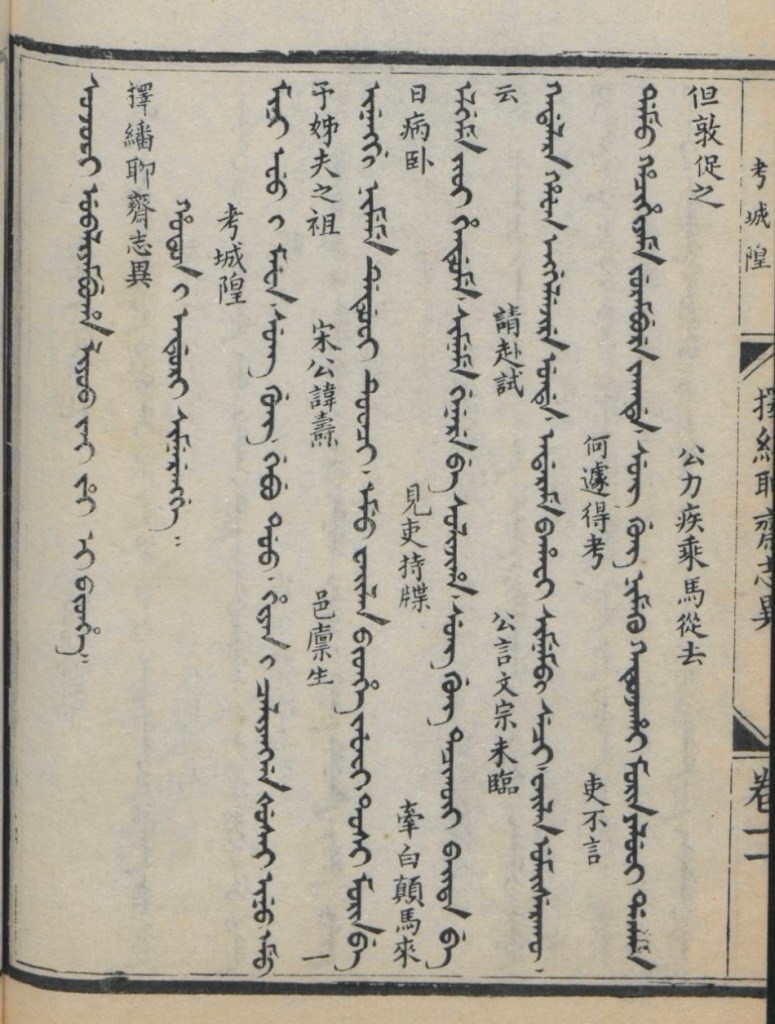
line 4-6
Note: I’ve realized that I have a different habit compared to North American Manchu studies—I prefer to romanize ᠴᡳ as “-qi” rather than “-ci.” Just clarifying again.
line 4
- “nimembi” ᠨᡳᠮᡝᠮᠪᡳ The verb in its base form primarily means “to feel pain” or “to be sick.” Here, it is used in the imperfect converb form “-me,” which some textbooks may refer to as a “verb used as an adverb.” This form indicates a continuous state or the relationship between two simultaneous actions. For example: maksime uqulembi ᠮᠠᡴᠰᡳᠮᡝ ᠴᡠᠯᡝᠮᠪᡳ means “singing while dancing” 载歌载舞
- “dedufi tuwaqi,” ᡩᡝᡩᡠᡶᡳ ᡨᡠᠸᠠᠴᡳ is quite interesting. The logic of sentence segmentation in Manchu differs from that in Chinese. “dedumbi” is the base form of the verb meaning “to lie down.” Here, it changes to the “-fi” form, which is a type of imperfect converb, indicating that one action precedes another. In other words, the action of “lying down” occurs first, followed by “tuwaqi.”
“tuwa-” is the base form of the verb “to see,” and here it changes to the -qi form. Manc.hu explains this as a conditional converb, but mechanically translating it as “if he saw” doesn’t make sense in this context. The article “On Evidential Strategies in Manchu” by Liliya M. Gorelova of the Russian Academy of Sciences and Arthur Chen of Shandong University provides a detailed explanation of this phenomenon in Manchu. The article states:
“Derived from the verbal stem tuwa- together with the suffix of the conditional converb “-qi,” this verbal form is designed – first of all – to signal that the information was acquired through visual perception.”
Moreover, -qi also has the meaning of “through” when used as a case particle. So in this context, it means “seen through one’s gaze.”
- It seems like the “bithe” ᠪᡳᡨᡥᡝ might have a bit of a broken or incomplete initial stroke in its appearance! 🙂
- “jafambi,” ᠵᠠᡶᠠᠮᠪᡳ is the base form of the verb meaning “to take in the hand.” In this context, it appears in the “-fi” form, which is a perfect converb. This usage indicates the sequence of actions, modifying the following noun while informing the reader that the action of “taking” has already been completed. (However, I believe it could also be interpreted as an imperfect converb because “taking” can be a continuous action. This dual interpretation allows for flexibility in understanding the sequence and duration of the action, depending on the specific context.)
line 5
- “elgeme jifi hendume” “elgembi” ᡝᠯᡤᡝᠮᠪᡳ means “to lead an animal by the reins.” “jimbi” ᠵᡳᠮᠪᡳ means “to come.” “hendumbi” ᡥᡝᠨᡩᡠᠮᠪᡳ means “to say. The logic of this phrase is as follows: elgeme functions as an imperfect converb modifying jimbi, indicating “how” the action of “coming” is performed. “jimbi” is in the “-fi” form, a perfect converb, which indicates a sequential relationship with the subsequent action “hendumbi.” The sequence is: leading the horse and coming, then speaking. In the context of reported speech or quotation in Manchu, the -me form can also function as a conjunction-like form to introduce direct or indirect speech, similar to how “saying” is used in English. (? I’m not sure about this)
- “genembi” ᡤᡝᠨᡝᠮᠪᡳ means “to go,” and ”genere“ is the imperfect participle form. When combined with ”simneme“ ᠰᡳᠮᠨᡝᠮᡝ means “to take the exam (imperfect converb),” these forms together serve as the object of “be.” This construction indicates that the action “going to take the exam” are both part of what the accusative case particle “be” is acting upon. “solinjimbi” ᠰᠣᠯᡳᠨᠵᡳᠮᠪᡳ means “to come to invite.” In this context, it is in the past tense, indicating that the action of coming to invite someone has already occurred.
- The phrase “taqikvi baita be kadalara hafan”ᡨᠠᠴᡳᡴᡡᡳ ᠪᠠᡳᡨᠠ ᠪᡝ ᡴᠠᡩᠠᠠᡵᠠ ᠠᡶᠠᠨ translates to “提督學政; Superintendent of Provincial Education.” However, the original Chinese term “文宗” refers to a “master of literary arts,” someone highly respected for their writings. The term originally described a person whose literary works were revered by many, as seen in Hou Han Shu (History of the Later Han), where it states: “崔为文宗,世禅雕龙” (“Cui was revered as a master of literary arts, whose writings were like a dragon carved in stone”). During the Qing Dynasty, this term was used as an honorary title for the provincial education superintendent.
line 6
- I’m actually not quite sure how “enggelejere” ᡝᠩᡤᡝᠯᡝᠵᡝᡵᡝ is conjugated here. “enggelejere” is a combination of “enggelembi” (to border on, to overlook, to command a view of) and “jimbi”(to come). “jimbi” is an unregularly conjugated verb. It should be “jidere” when it is conjugated independently. unde ᡠᠨᡩᡝ : (after -ra/re/ro) not yet, e.g. cooha isinjire unde ‘the troops have not arrived yet’
- “adarame bahafi” ᠠᡩᠠᡵᠠᠮᡝ ᠠᡥᠠᡶᡳ is a fixed expression and it is an interrogative word meaning “how.”
- seqi: (auxiliary, closing a subordinate clause) “when, although …”
- umaiserakv ᡠᠮᠠᡳᠰᡝᡵᠠᡴᡡ —I haven’t figured this one out yet… Anyway, it’s the last word, so I’ll leave it for the next article.

 Sijian Wang’s Academic Blog